Integrated Drone Logistics
Last-Mile solutions using drone technology
Conceptual Simulations / Creative Thinking


Drone to the Future in Logistics
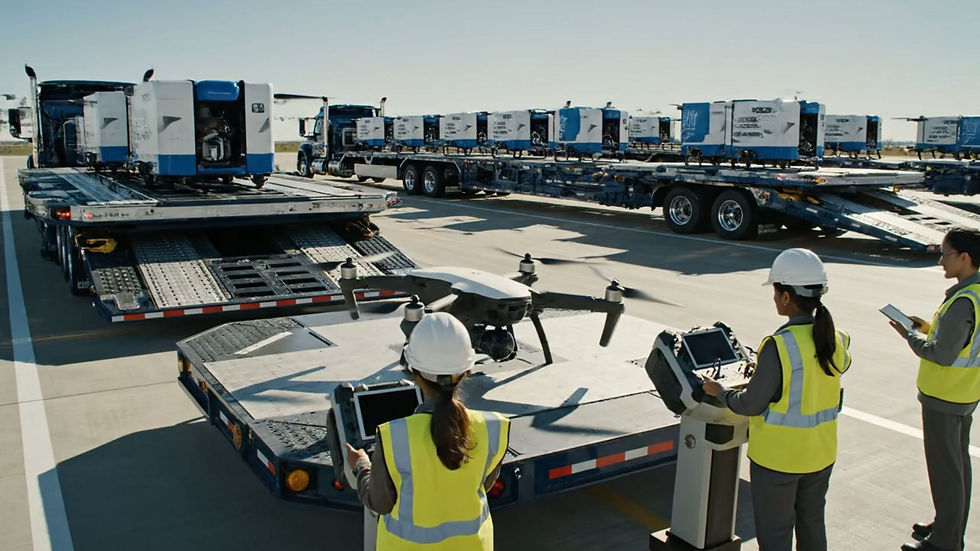
Drone to the Future is a next-generation delivery approach built for the places traditional last-mile struggles, remote routes, spread-out stops, tight delivery windows, and hard-to-reach locations. Instead of relying only on a van route, deploy a Mobile Operations Deployment (MOD) unit (a truck and trailer) that stages inventory closer to the delivery area and launches drones for fast, point-to-point drop-offs and return pickups.
This model isn’t designed to replace standard delivery everywhere. It’s designed to add speed, flexibility, and reach where it matters most, reducing wasted miles, improving service in low-density zones, supporting surge demand, and capturing returns faster. With support from a control center and transfer yards for quick swaps and battery charging, Drone to the Future keeps deliveries moving even when roads, distance, or access become the bottleneck.
Conceptual Simulations / Creative Thinking
Mobile Operations Deployment (MOD) Network
A mobile trailer-based micro-distribution platform that launches drones for last-mile delivery and return pickup, supported by a Control Center, a MOD Transfer Yard (MODTY), and a replenishment shuttle (ReMOD).
Objectives
-
Extend last-mile reach into remote / low-density zones with a repeatable operating model.
-
Stage inventory closer to delivery points to reduce cycle time and improve service.
-
Maintain scan-based chain-of-custody for outbound and returns at every handoff.
-
Enable rapid redeployment via MODTY swaps and ReMOD replenishment loops.
Operational Flow
(End-to-End)
-
1) DC Load & Dispatch: pick/pack into storage module; verify labels and payload eligibility; forklift-load onto MOD; tie-down + lock + optional tamper seal; Control Center assigns destination and mission list.
-
2) Arrival & Go Live: park in approved location; set cones/chocks/perimeter; perform weather/obstacle checks; confirm
geofence/no-fly constraints; verify with Control Center (GPS + confirmation code). -
3) Delivery Cycle: scan package ID; confirm battery threshold; Control Center authorizes; launch; capture proof of delivery (photo/OTP/QR per policy); recover; swap batteries as needed; repeat.
-
4) Return Pickup: Control Center verifies RMA/QR/ID; drone retrieves return; MOD scans and marks in custody; secure in dedicated return zone within module.
-
5) MODTY Swap & Charge: check-in scan for trailer/module; verify seal/lock condition; swap to “ready” module/trailer; rapid battery charging and optional battery pool support.
-
6) ReMOD Loop: DC ® MODTY delivers multiple new modules; MODTY ® DC returns consolidated returns; custody scans required at every transfer.
Exception Handling (High-Level)
-
Failed delivery: retry per policy > alternate
approved method > return to MOD if unresolved. -
Drone issue: fail-safe return-to-home/safe landing
> recovery plan > drone grounded until cleared. -
Safety risk: immediate stand-down; relocate if
needed; resume only when cleared. -
Security mismatch: stop operations; report; inspect; resolve before continuing.
System Components
-
MOD Unit: 1-ton truck + trailer; forklift-loadable
storage module; two drone charging docks; solar support; safety perimeter kit; scanners; spare batteries. -
Control Center: dispatch, GPS + code verification, mission authorization, monitoring, exception handling.
-
MODTY: swap yard for modules/trailers, rapid
charging, optional battery pool, return consolidation. -
ReMOD: shuttle that moves multiple modules
between DC and MODTY and returns consolidated returns to DC.
Safety, Security, and Compliance Rules
-
No launch without a clear launch/landing zone and controlled perimeter; pause operations if bystanders enter the perimeter.
-
Mandatory stand-down for unsafe weather, new no-fly restrictions, or law enforcement/property request.
-
Launch authorization requires GPS verification + confirmation code with the Control Center.
-
Full scan-based chain-of-custody for outbound and returns; stop operations for any ID mismatch or tamper indication.
-
Battery health tracking: minimum launch threshold, fault quarantine, and documented swap/charging cadence.
KPIs (Success Measures)
-
On-time delivery % and first-attempt success %
-
Drone mission success rate % and average delivery cycle time
-
Returns cycle time (pickup to DC receipt)
-
Scan accuracy / custody compliance %
-
MODTY turn time (drop/pick speed) and ReMOD
loop cycle time -
Battery failure rate and safety/security incident rate
-
Cost per successful delivery vs baseline

Cutting-Edge Technology
Reliability Guaranteed
Customer-Centric Approach